
The Connecticut River Fishes Like Three Different Rivers. Most Anglers Only Ever Find One.
What Most Anglers Miss About the Connecticut River
Plenty of anglers show up below the Enfield Dam for their first shad run with the wrong weight, the wrong retrieve, and too much confidence in tackle built for Long Island Sound, then watch the regulars a few spots down land fish after fish while they struggle to find one. That's the Connecticut River's way of introducing itself, on its terms, not yours.
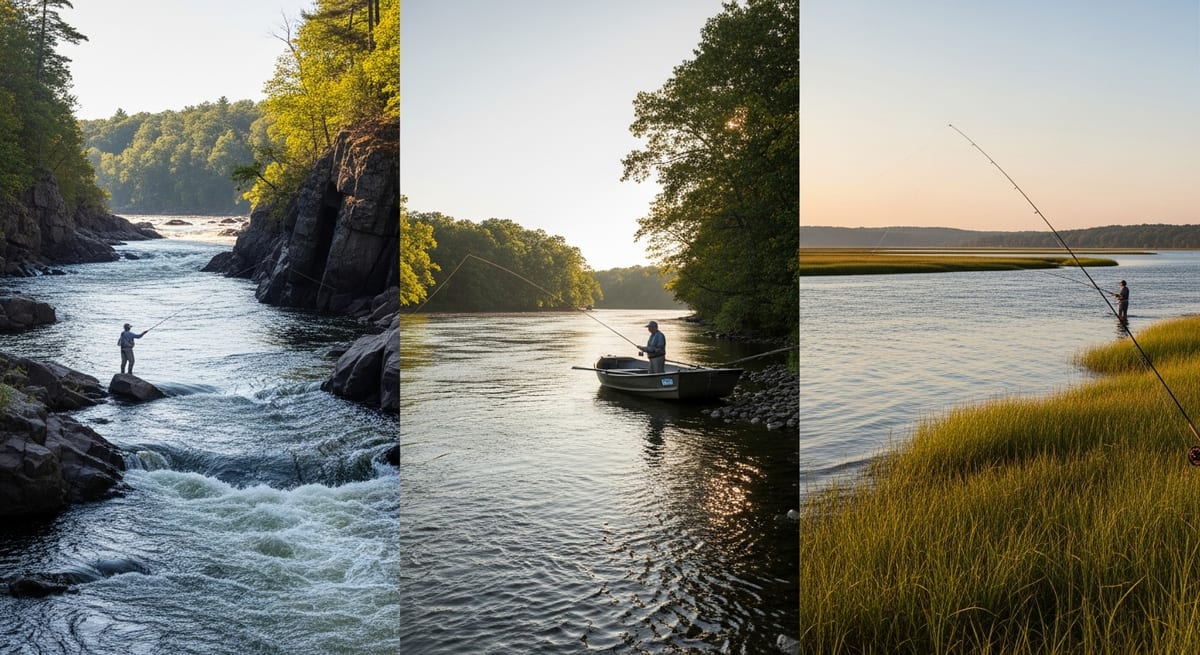
What takes many anglers a few seasons to fully appreciate is that the CT River isn't one fishery. It's three stacked into a single corridor, and most anglers only ever show up for one of them. There's the upper river above Hartford where smallmouth hold in rocky structure. There's the middle river, enfield down through Middletown, where the shad migration draws crowds in May and channel catfish take over after dark in July. And there's the tidal lower river from Haddam to Old Saybrook, where striped bass push upstream chasing bait in spring and stage for their coastal run in October.
The river runs 410 miles from the Canadian border to Long Island Sound, and the lower third through Connecticut carries what the EPA designated an "Estuary of National Significance". A nod to its recovery from decades of heavy industrial damage. The fish came back strong: striped bass, American shad, hickory shad, channel catfish, largemouth and smallmouth bass, northern pike, white perch, and carp. For anglers, the conservation story is secondary. The fishing is the story.
The CT River's Seasonal Calendar (And Where the Gaps Are)
Spring (April-June). The Shad Migration: The Connecticut River shad run is arguably the most social fishing event in the state, and that reputation is earned. American shad push upriver through April and typically into June, with peak action falling around mid-May in most years. The timing shifts with water temperature, in a cold spring, don't expect the run to peak on the same week it did last year. The CT DEEP tracks daily catch at the dedicated shad area near the Enfield Dam during the run; that data is more reliable than any calendar estimate.
Hickory shad follow a similar track, running slightly later and smaller than American shad. Stripers follow the bait upriver in May, bigger fish, 30 inches and up, stacking behind points and in current seams from Haddam all the way up to Enfield.
Summer (July-August), night Cats and Backwater Bass: The shad crowd clears out, the river slows, and channel catfish take center stage. Warm water concentrates them in the deeper holes and beneath undercut banks. Some of the best catfish on this river come on cut shad fished after midnight near the Haddam stretch. Largemouth bass move into backwater coves and oxbow ponds in the tidal lower river. White perch are thick throughout the tidal section and will hit almost anything small enough to fit in their mouths.
Fall (September-November). Striper Window: October is when the tidal lower river earns serious attention. Bass staging before their coastal migration bunch up near creek mouths and shoals. Some of the best CT River striper fishing comes not in May but in the third week of October, when most anglers have already switched to deer season. Some hickory shad make a fall run as well, american shad are strictly a spring species on this river.
A note on walleye: The CT River corridor near the Massachusetts border does hold some walleye, but they're not a reliable target for most anglers fishing the Connecticut sections of the river. If walleye is your primary goal, dedicated CT walleye waters elsewhere in the state are a more consistent bet than chasing them on the CT River.
Seven Access Points Worth Returning To
A few of these are easy to skip because the launch doesn't look like much from the road. That's a mistake. The river's best spots don't always advertise themselves.
Enfield Dam (Enfield): The CT DEEP maintains a dedicated shad fishing pier and boat launch adjacent to the Enfield Dam. The pier fills up fast on peak shad days in May, arrive early or accept a crowd and a shorter stretch of rail. Stripers stack below the dam in mid-to-late May, and even when the shad action slows the structure here holds fish through spring.
Windsor Locks Canal: The historic navigation canal that parallels the river has a walkable towpath running its length, fishable, quiet, and underused compared to Enfield. Good shore access for bass, catfish, and white perch. Worth a midweek visit when the Enfield crowd is too thick to fish comfortably.
Cromwell Town Launch: A reliable boat launch with access to the middle river. A productive bass and catfish stretch that most anglers drive right past on their way north.
Haddam Meadows State Park (Haddam): Large state boat launch with shore fishing access. The catfish stretch south of here is excellent in summer, and parking is manageable most weekdays. Easy logistics matter more than anglers admit.
Salmon River Confluence (East Haddam): Where the Salmon River meets the Connecticut. The mixing current draws migratory stripers in spring and fall, and the bass fishing around the confluence points is legitimately good in October, one of those spots that rewards the angler willing to look past the obvious.
Gillette Castle State Park (East Haddam): Shore access to the tidal river. Less crowded than Haddam Meadows, worth the drive when the tide is running hard and you want the water to yourself.
Selden Neck State Park (Lyme): Boat-access only, and that filters out the casual crowd. The largemouth habitat in the coves around Selden Neck is among the best on the tidal CT River. Bring an anchor and fish slow. This isn't a spot you cover quickly.
Getting Schooled at Enfield: How to Actually Fish the Shad Run
The regulars in lawn chairs who catch twice as many shad as everyone else aren't doing anything magical. They've learned to read the seams. Most anglers need several trips to Enfield before they stop guessing and start watching more carefully.
Gear: Light to medium spinning rod, 6-8 lb monofilament or 10 lb braid. Shad have soft mouths and fight harder than their size suggests. Don't horse them. Rushing a fish to the net is an easy way to lose it, so give them room to tire out.
Lures: Shad darts in 1/4-3/8 oz, chartreuse or pink, are the standard and they work. Small Swedish Pimples and shad spoons also produce when the fish are being selective. The retrieve that consistently outperforms everything else: cast upstream at a 45-degree angle, let the dart settle toward the bottom, then slow-roll back with occasional short lifts. The bite is almost always subtle. A slight heaviness, a hesitation, something that doesn't quite feel like current. If you're waiting for a hard strike, you'll miss half your fish.
Fly fishing: Many anglers come to shad on a fly rod late and regret the years they waited. A 6 or 7-weight with a sink-tip, a small bright clouser or dedicated shad fly, and the patience to mend properly. It changes what shad fishing is. They fight differently on a fly rod than anything else in Connecticut spring fishing. The Enfield run draws serious fly anglers from across New England specifically for this, and watching someone work the seams well with a long rod is the kind of thing that makes you want to go home and practice your mending. Don't wait to try it.
River Stripers Are Not Sound Stripers, here's What Changes
Anglers who do well on striped bass in Long Island Sound sometimes struggle the first time they bring those tactics to the Connecticut River. The fish are the same fish. The current changes everything about how you present to them.
Spring stripers push upriver chasing shad and river herring, not clams, not sandworms. The bait profile matters. Live shad is the top option when you can get it. Big paddletail swimbaits in 5-7 inches and heavy bucktails fished in the current seams produce consistently. The most common mistake is fishing too slowly, in active river current, your lure needs to work against the water to trigger the reaction. Cast upstream, feel the current load the bait, then let it swing through the seam like something struggling to hold position.
Spring: The obvious target is below the Enfield Dam, and it earns that reputation. But the stretch from Haddam upstream through Middletown is worth fishing when Enfield is standing-room-only. The tidal influence reaches Hartford, which means a dropping tide at dawn between Haddam and Middletown fishes well even when the crowd has stacked itself at the dam.
Fall: October is the time to shift your CT River focus entirely to the tidal lower river from Old Saybrook up through Haddam. Bunker schools in the lower tidal section concentrate the biggest fish of the fall, large soft plastic swimbaits, live bunker under a float, or chunked bunker on the bottom all work. It's one of the better fall striper fisheries in the state, and it doesn't require a long offshore run or a big boat.
Tide: Fish the transitions. The last hour of incoming and the first hour of outgoing consistently produce the most action. Slack water goes quiet fast on this river, don't let it fool you into thinking the bite is off. Wait twenty minutes and pick a new spot on the moving water.
EVERY SATURDAY MORNING
Weekly fishing intelligence
Nationwide conditions, what's biting, and honest gear deals. One email, no noise.
No spam. Unsubscribe anytime.