
Connecticut's Crappie Fishery Fits on a Short List. Bantam Lake, Wononscopomuc, and What CT DEEP Survey Data, 2025-2026 Freshwater Regulations, and Litchfield County Panfish Anglers Report About Structure, Ice-Season Schools, and the Narrow Spring Bite Window.
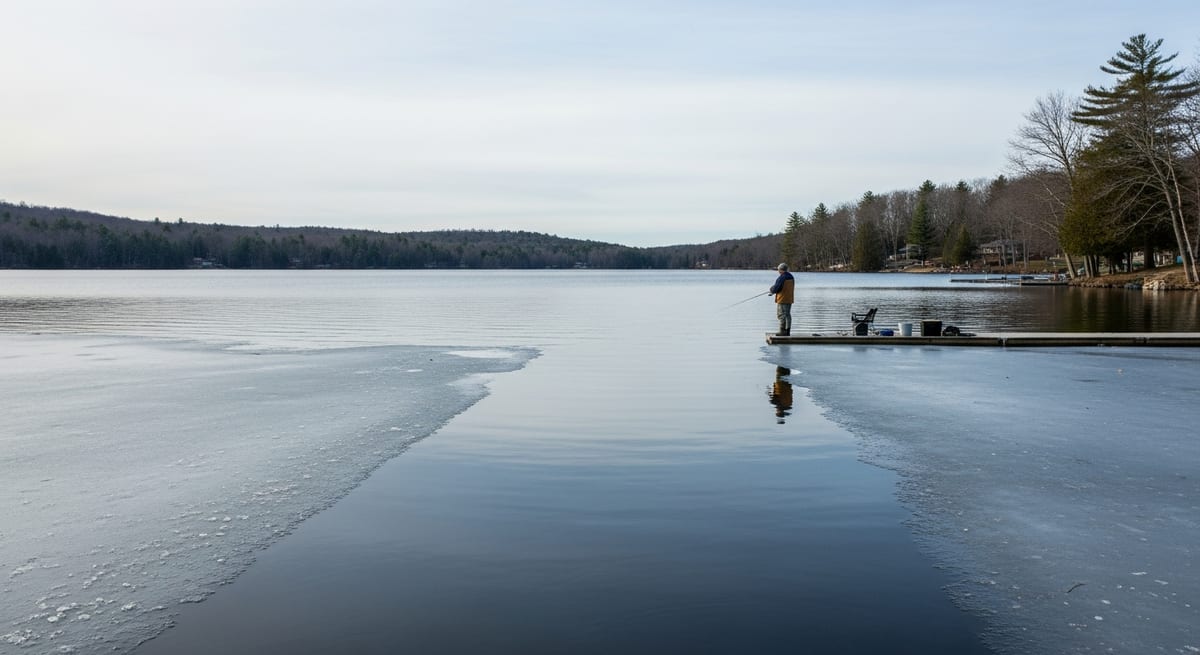
Bantam Lake's brush-pile corridors, mapped informally by Litchfield County panfish regulars and referenced in CT DEEP periodic lake assessments, hold the most concentrated black crappie population in Connecticut. The fishery draws anglers from across the northwest corner every April, yet remains largely unknown outside that community. CT DEEP 2025-2026 freshwater regulations set a 25-fish daily crappie limit statewide with no minimum size, but anglers who fish Bantam consistently note that the productive window is narrow: roughly the two to three weeks surrounding ice-out when fish move shallow before dispersing to mid-depth structure by June. This guide covers what CT DEEP survey data, community ice reports, and the Litchfield County crappie community have documented about finding and catching black crappie in Connecticut waters.
Where CT Crappie Actually Live: Bantam, Wononscopomuc, and the Short List
Connecticut's crappie population is concentrated in a short list of lakes rather than distributed broadly across the state. Black crappie (Pomoxis nigromaculatus) are the primary CT species, better adapted to the clearer and cooler impoundment conditions found in Litchfield County than white crappie, which appear only occasionally in warmer CT River-adjacent waters.
Bantam Lake (Morris/Litchfield): The most well-established crappie fishery in Connecticut. Anglers who fish Bantam regularly describe consistent 10-12 inch fish from the brush-pile corridors in the north cove, with larger fish possible near dock structure along the eastern shoreline. Shore and launch access available via town access points on the north shore.
Wononscopomuc Lake (Salisbury): Northwest CT crappie water that draws less pressure than Bantam. The consensus among Salisbury-area anglers is that fish run slightly larger on average, with 12-14 inch crappie reported more consistently here than at other CT waters. Public boat launch available via town access in Salisbury.
Highland Lake (Winsted): Crappie present in moderate numbers. Reports from CT angling forums indicate a smaller average size than Bantam or Wononscopomuc, but populations are consistent enough to be worth targeting in the Winsted area. Town boat ramp off Highland Lake Road.
CT River oxbow lakes: Several slow-water oxbow sections and tributary impoundments support crappie, though populations tend to be less stable than the Litchfield County lakes. No established community knowledge base exists for most of these waters.
Seasonal timing follows two productive windows: spring (mid-April through May) when fish move shallow before and during the spawn, and fall (September-October) when water cools and schools feed actively. Midsummer crappie typically drop to 15-25 feet and school tight. Locating them requires electronics.
What CT DEEP Survey Maps and Bantam Regulars Document About Crappie Structure
Crappie are schooling fish with a strong affinity for specific structure types. CT anglers who target crappie consistently, particularly on Bantam and Wononscopomuc, describe a predictable structural hierarchy that holds across seasons.
Brush piles: Submerged brush piles, both natural deadfall and artificial fish attractors installed by CT DEEP and local fishing clubs, are the primary crappie concentration points. Their locations in Bantam are documented informally by the local angling community; asking at the Bantam area bait shops typically yields current coordinates. The brush aggregates invertebrates and small baitfish, giving crappie both cover and a food source in one location.
Dock structures: Older docks with deep water access hold crappie throughout the season. Unlike bass, which typically hold on outside dock edges, crappie often suspend inside dock structures at mid-depth. Bantam dock-fishing regulars flag this positional difference as the most common mistake anglers bring over from bass fishing.
Standing timber: Lakes with flooded timber from old reservoir construction hold crappie suspended around submerged trunks at mid-water column. Vertical jigging around standing timber is the standard approach; dropping a jig past fish at the wrong horizontal angle without triggering a strike is a known issue.
Weed edges: The outside edge of weed beds in 8-12 feet of water holds crappie during the spring transition from winter depths. As water warms through May, community reports from Bantam indicate fish migrate progressively toward brush piles and dock structure.
Open water in fall: When crappie school in October, Bantam regulars report they sometimes suspend in open water with no structural reference. A depth finder becomes the only reliable locating tool.
The CT Crappie Rig: Light Tackle Setups That Bantam and Wononscopomuc Anglers Reach For
Crappie fishing is finesse-oriented compared to bass or pike fishing. The light-tackle approach is driven by biology: crappie have good eyesight and are more line-shy than most CT panfish species.
Rods: A 5.5-7 foot ultralight spinning rod covers most situations. Anglers who fish dock structure and brush piles heavily, particularly the Bantam regulars, often use longer 9-12 foot crappie rods for vertical presentations. The extra length allows depth control without a long cast, which matters when fish are directly below dock structure.
Line: 4-6 lb fluorocarbon is the typical choice among CT crappie anglers; monofilament in the same range works as a budget option. Light line matters more for crappie than for most CT freshwater species.
Jigs: Small tube jigs (1.5-2 inch) and curly-tail grubs in the 1/16-1/8 oz range are the primary artificial. Colors that CT crappie anglers report consistently: chartreuse, pink, white, and yellow with a contrasting body. Slow vertical presentations typically outperform horizontal retrieves in brush pile and dock situations.
Small spinners: Marabou jigs and small inline spinners (Mepps #0-1 size) work in open water and along weed edges during the spring run.
Live minnows: Community reports from CT crappie anglers consistently place live minnows, specifically 1-2 inch shiners on a small hook under a bobber set to depth, as the most reliable presentation when artificials go cold. Crappie are primarily minnow feeders, and live bait often triggers strikes during mid-day lulls when jigs stop producing.
Ice-Season CT Crappie: What Bantam Lake and Wononscopomuc Winter Reports Document About Under-Ice Schools
Ice fishing represents one of the most consistent crappie periods in Connecticut. Schools concentrate tightly under the ice, and fish are easier to locate than in open water. Bantam Lake ice reports from CT fishing communities consistently note crappie suspending at mid-depth over brush pile structure rather than holding on the bottom, a behavioral distinction that costs anglers time when they're jigging at the wrong level.
Electronic sonar through the ice hole is described by experienced Bantam ice anglers as close to essential. A flasher sonar (Vexilar FL-8 or a comparable Marcum unit) allows real-time depth confirmation, letting anglers see the exact level fish are holding and adjust the jig accordingly rather than blind-jigging through the water column.
Setup: Small tungsten ice jigs in the 1/32-1/16 oz range drop faster than lead and maintain a horizontal hang angle that CT ice crappie anglers find more productive than lighter lead jigs. Micro soft plastics, including tiny tubes and slim grubs, on small hooks in sizes 8-12. Adding a small live or dead minnow to the hook increases catch rates noticeably, according to consistent community reports from Bantam and Wononscopomuc ice seasons.
Bite detection: Crappie bites through ice are often subtle. A slight hesitation in the jig's downward travel, or a minor upward twitch, indicates a strike. A spring bobber, the small flex indicator attached to the rod tip, is standard among CT crappie ice anglers for exactly this reason.
Depth: Most CT ice crappie fishing happens in 10-18 feet of water over brush or dock structure. Community reports from Bantam note that fish may shift depth within that range through the day, with afternoon periods when fish rise 2-4 feet shallower than their morning position.
2025-2026 CT DEEP Freshwater Regulations and What Community Reports Say About Crappie Table Quality
Under CT DEEP 2025-2026 freshwater regulations, the daily crappie limit is 25 fish per angler in most waters, with no minimum size limit. Always verify against the current CT DEEP Freshwater Fishing Guide for your specific water body, as special regulations can apply to individual managed lakes.
Cleaning: Crappie fillet cleanly for their size. The slightly larger body compared to bluegill produces a useful palm-sized fillet from fish in the 10-12 inch range. Anglers who fish Bantam regularly report that scaling and pan-frying smaller fish whole, gutted with head removed, is common practice for fish under 9 inches.
Preparation: The standard approach across CT crappie communities is a light cornmeal or seasoned flour coat, pan-fried in butter to a golden crust. The white, flaky flesh is mild and holds up well to simple preparation. Community reports from the CT crappie community describe crappie as among the more approachable freshwater fish to cook, with less of the muddy flavor that bluegill occasionally carry from warmer, murkier water.
Yield and planning: A 10-12 inch crappie yields roughly a palm-sized fillet per side. CT crappie anglers who plan a fish fry typically work toward 3-4 fish per person, achievable within the 25-fish daily limit when fish are cooperative. The spring run at Bantam, in particular, is the window when local reports most frequently describe limits being reached before noon.
EVERY SATURDAY MORNING
Weekly fishing intelligence
Nationwide conditions, what's biting, and honest gear deals. One email, no noise.
No spam. Unsubscribe anytime.