
CT Bass Anglers Who Fish Jigs Swear by Fast Action. The Crankbait Crowd Thinks That's the Wrong Call. Both Are Right.
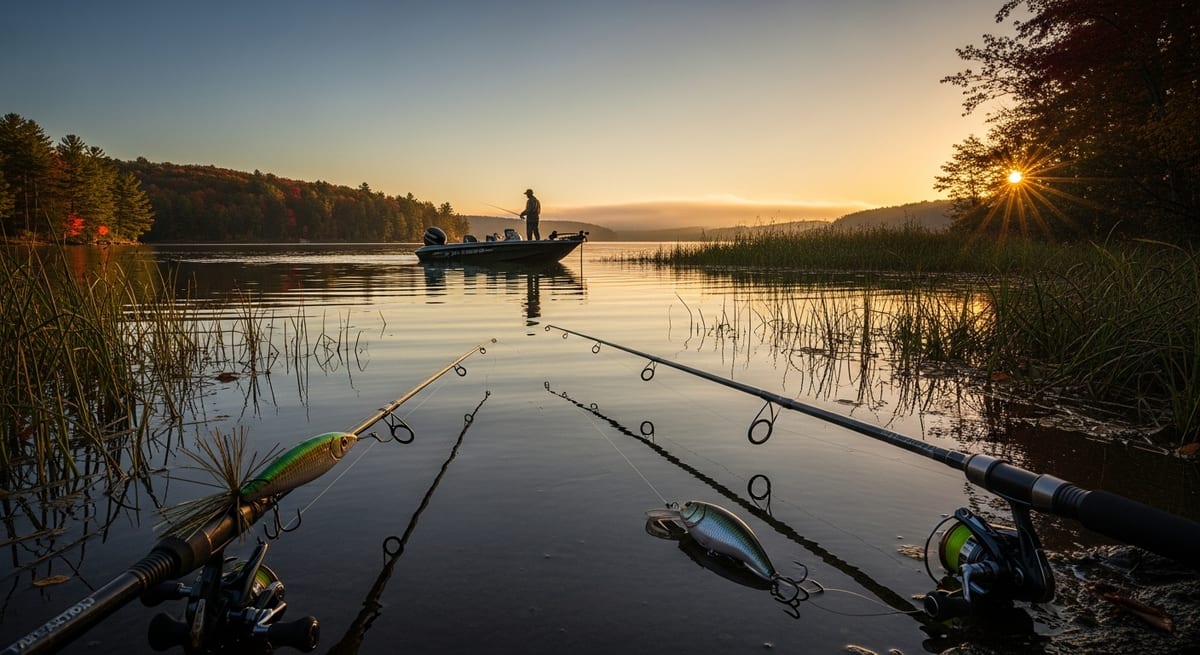
Rod action is the spec printed on the blank near the handle that CT bass tournament regulars consistently identify as the most consequential variable recreational anglers aren't reading. Not lure weight range, not line test: the three-letter descriptor, fast, moderate, slow. That describes where the rod bends when it loads. Get it wrong for your technique and the rod works against you on every hookset. The three specs together, power, action, and length, tell you exactly how a rod performs before you ever pick it up. Anglers fishing CT's reservoir bass circuit, the Farmington's catch-and-release sections, and the LIS surf have converged on specific setups for specific techniques, and the specs behind those choices are legible to anyone who looks.
Rod Power: Most CT Freshwater Anglers Only Need Four of the Six Options
Power describes overall rod stiffness, how much force it takes to load the blank through a cast or hookset. The full spectrum runs from ultra-light to extra-heavy, but for most CT fishing, the edges of that spectrum rarely come up.
Ultra-light to Light: For the Farmington's catch-and-release sections, the Housatonic's upper trout water, and small-stream fishing generally, anglers typically run ultra-light or light spinning setups. Lure ranges vary by manufacturer, but these rods are built for small presentations, light jigs, micro spinners, small soft plastics, and light line. The light tip amplifies every headshake from a 10-inch brown trout, which is the point. Panfishermen on CT ponds and the small bass coves run the same power class for the same reason.
Medium-light to Medium: The practical workhorse for most CT freshwater fishing. Anglers targeting bass on Candlewood, walleye on the Squantz dropoffs, and smallmouth on the lower Housatonic regularly reach for medium-light or medium spinning setups. These cover finesse bass applications, drop shot, Ned rig, lighter jigs, where sensitivity matters more than backbone.
Medium-heavy: The most commonly cited power among CT bass tournament anglers, according to regulars on the CT bass fishing forums. Texas rigs, heavier jigs, and spinnerbaits in the heavier half of their range demand backbone the lighter powers often can't deliver on the hookset. Anglers fishing the bass coves on Lake Lillinonah and the rocky points on Barkhamsted Reservoir commonly run at least one medium-heavy setup.
Heavy and Extra-Heavy: Specialized applications. LIS surf anglers throwing heavy plugs for stripers typically need heavy power to handle the presentation and drive big hooks. Most CT freshwater fishing never touches this end of the spectrum.
Rod Action: The Spec That Explains Why the Jig Crowd and the Crankbait Crowd Run Different Rods
Action describes where along the blank the rod flexes under load. Power tells you how stiff; action tells you where the stiffness is concentrated. They're independent. A medium-heavy fast and a medium-heavy moderate perform very differently even with identical power ratings.
Fast action: The blank loads primarily in the upper portion of the rod, with the lower section staying comparatively stiff. CT bass anglers who fish jigs and soft plastics run fast action almost universally. The stiffer lower section transmits bottom feel and subtle strikes directly to your hand, and the rod responds immediately when you lift into a fish. Drop shot on Candlewood, Texas rig on Barkhamsted structure, finesse jigs on the Squantz rocky shoreline, fast action is the consistent choice when you're reading the bottom and setting hooks quickly.
Moderate action: The rod bends through roughly the upper half of the blank, creating a more parabolic flex. This is the crankbait rod. When a bass hammers a treble-hook lure, a fast-action rod can pull the hooks before they take hold. The tip amplifies the strike rather than absorbing it. A moderate blank loads into the hit and keeps tension on the fish through the fight. Anglers who've switched from fast-action rods to moderate for crankbaits and jerkbaits, on CT reservoirs and elsewhere, consistently report better hookup and landing ratios after the change.
Slow action: Bends throughout most of the blank. Primarily used for ultra-light panfish and stream trout fishing where cushioning the energy of a small fish is the goal. Not a common choice for bass or larger species.
Fast action for jigs, soft plastics, and worm rigs. Moderate action for crankbaits, spinnerbaits, and topwater. This one distinction accounts for more avoidable lost fish than most anglers realize.
Length: Casting Distance, Boat Size, and What the CT Reservoir Circuit Has Landed On
Longer rods (7 ft and up) generate more tip speed for the same wrist input, which means more distance on open-water casts. Shore anglers fishing CT reservoirs benefit from the extra reach. LIS surf anglers commonly run 9-10 ft rods specifically to punch presentations through the wave wash and reach stripers from the beach.
Shorter rods (under 6'6) trade distance for precision. Dock fishing, flipping heavy vegetation, tight-cover situations where the target is close, shorter rods give you more control where a 7'6 blank becomes a problem. Many anglers fishing the dense shoreline cover on Lake Zoar and the lily pad flats on smaller CT ponds carry one shorter rod for exactly this.
The range most CT bass anglers land on is 6'9-7'3. Community consensus among tournament anglers fishing the CT bass circuit and the broader Northeast freshwater community consistently points to this range as the balance point between casting distance, fish-fighting leverage, and manageable length in a small aluminum boat. Many experienced anglers recommend a 7'0 medium-heavy fast action baitcasting rod as a starting point for a first baitcasting setup. It covers enough techniques to be genuinely useful without being a specialist tool.
Spinning vs. baitcasting: Spinning rods carry guides on the underside of the blank; baitcasting rods carry them on top. Spinning handles lighter presentations more effectively and has a much shorter learning curve. Baitcasting delivers more accuracy and leverage for heavier techniques once the muscle memory is built. Most CT trout and panfish anglers stay on spinning. Bass anglers who fish a range of techniques, light finesse work in the morning, heavier structure fishing in the afternoon, often run both.
What CT Anglers Have Converged On for These Techniques
These setups reflect what regulars on the Farmington, Housatonic, LIS, and CT reservoir circuit have settled on over time. Lure weight ranges vary by manufacturer spec, so treat them as starting points.
Drop shot / finesse bass (Candlewood deep points, Squantz Pond rocky structure): 6'9-7'0 medium-light to medium, fast action spinning rod. The fast tip telegraphs the light bottom contact that drop shot fishing depends on reading. Anglers targeting Candlewood's deeper basin in summer and Squantz's rocky transitions report this as their most-used warm-weather setup.
Texas rig / bass jig (CT reservoir structure, Lillinonah, Barkhamsted): 7'0-7'3 medium-heavy, fast action baitcasting rod. The stiff lower blank drives hooks through soft plastic on the set, and the fast tip reads the bottom through the retrieve. This is the dominant setup among anglers fishing the rocky structure and submerged timber on the Housatonic impoundments.
Crankbaits (CT open-water bass fishing): 7'0-7'6 medium power, moderate action baitcasting rod. The parabolic flex keeps treble hooks pinned through the fight and helps load the cast efficiently for distance. The difference between this and a fast-action rod for cranking is measurable in landed fish over a season, according to tournament anglers who've run controlled comparisons.
Topwater (early morning, summer reservoir): 7'0-7'3 medium to medium-heavy, moderate-fast action. Needs enough give to prevent pulling trebles on the bite, with enough backbone to turn a fish once it's hooked and moving.
Trout (Farmington and Housatonic catch-and-release sections): 6'0-6'6 ultra-light to light, moderate-fast action spinning rod. Light enough to make a 12-inch brown a genuine fight; sensitive enough to read a nymph tick on the bottom. Anglers who fish both rivers regularly often carry the same rod to both.
LIS surf (stripers and blues, CT shoreline): 9'0-10'0 medium-heavy to heavy, fast to moderate-fast action. Long enough to clear the wave, stiff enough to drive hooks on long-distance sets. Most CT surf regulars run braided main line for the no-stretch feel that matters when the fish is 80 feet out.
EVERY SATURDAY MORNING
Weekly fishing intelligence
Nationwide conditions, what's biting, and honest gear deals. One email, no noise.
No spam. Unsubscribe anytime.