
The Freshwater-to-Tidal License Split, Not the Striper Slot, Is What Catches Farmington and Housatonic Anglers Off Guard Each Season. What the DEEP 2025-2026 Fishing Guide, Marine Division Updates, and Community Reports From Niantic to Candlewood Reveal About CT's Parallel Regulatory Systems
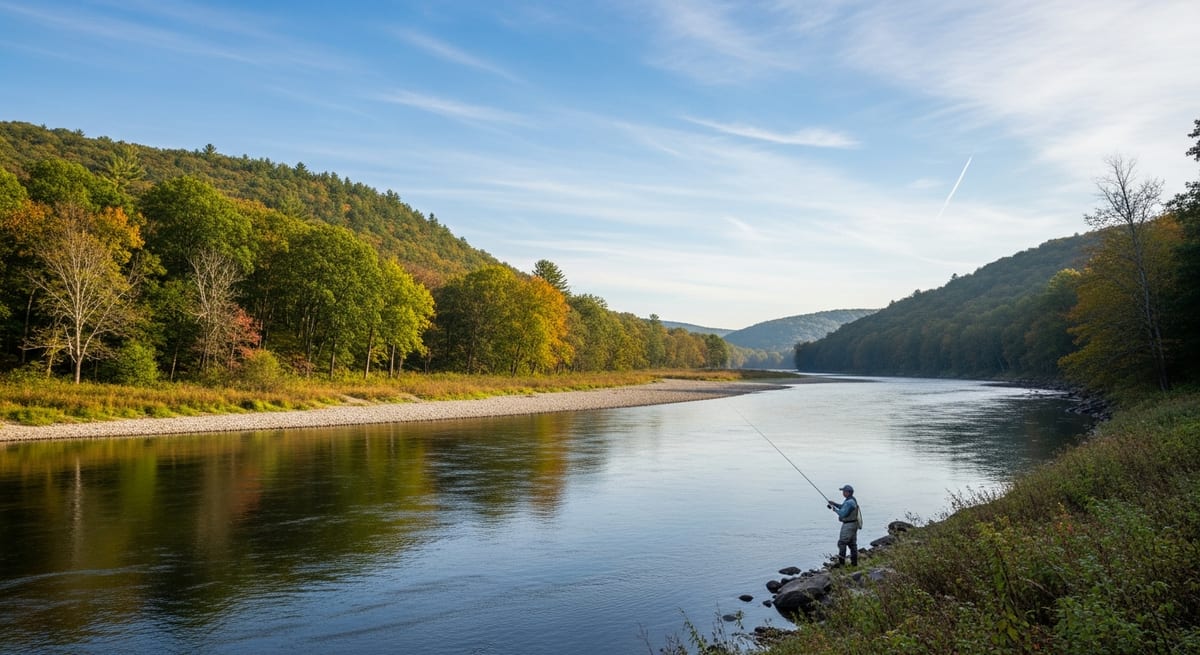
Shore communities along Niantic Bay and the lower Housatonic report the same conversation at the launch each spring: an angler who fished the Farmington all week picks up a saltwater registry card over the weekend, then discovers the tidal license was required before the first cast in brackish water, not after it. CT runs two parallel regulatory systems, freshwater and marine, and anglers who fish across both report that the crossover point, not any individual slot limit, is where the compliance gap consistently lives. Always verify with the current DEEP 2025-2026 Fishing Guide and the Marine Fisheries Division before the season. Some regulations update annually, and saltwater rules tied to ASMFC mandates can shift between seasons without much lead time.
The CT License Setup: What Freshwater, Tidal, and Both Actually Require
CT requires a freshwater fishing license for any angler age 16 or older on non-tidal inland waters. Annual cost is approximately $19 for residents and $40 for non-residents under current DEEP fee schedules, verify the current figures at ct.gov/deep before purchasing, as fees can adjust year to year. Anglers under 16 fish freshwater license-free.
For saltwater and tidal waters, a separate Recreational Saltwater Fishing Registry is required for all anglers 16 and older. The registry is currently free through the federal NOAA saltwater registry or through CT DEEP directly. Both are required for anyone fishing tidal stretches of the Housatonic, the Thames, the Niantic River, or any CT estuary, even if the target species is a freshwater fish holding in the tidal zone.
CT kayak anglers who run from a freshwater impoundment like Candlewood Lake in the morning to a tidal Housatonic cove by afternoon describe the dual-license gap as one of the most common compliance oversights they observe, particularly among freshwater anglers adding occasional saltwater or tidal trips. The Bantam Lake and Candlewood tackle shops that sell licenses note the same pattern in early May when the coastal push begins.
Licenses run January 1 through December 31. Purchase at ct.gov/deep or at any authorized license vendor; most CT tackle shops near Bantam, Candlewood, and the shoreline access points are licensed dealers.
The Freshwater Limits Where Community Reports Show the Most Confusion
Largemouth and Smallmouth Bass: 12-inch minimum, 5-fish daily limit, year-round open season under the DEEP 2025-2026 Freshwater Guide. Candlewood and Bantam regulars note the 12-inch threshold is one of the cleaner measurements in CT freshwater, confusion tends to cluster instead around bass caught in wild trout waters, where separate gear restrictions apply to everything in the stretch.
Trout (stocked waters): 8-inch minimum, 5-fish daily creel. The season opens the first Saturday of April on most stocked waters and runs through February 15. Wild trout management areas carry entirely separate rules. Farmington River regulars describe new anglers arriving opening week without checking whether their stretch falls under TMA regulations, which restrict gear and possession well beyond the statewide defaults.
Chain Pickerel: 15-inch minimum, 5-fish daily limit. Waters like Pachaug Pond and Rogers Lake carry strong pickerel populations; the 15-inch bar is higher than many anglers who grew up fishing for them in neighboring states expect.
Northern Pike: 24-inch minimum, 2-fish daily limit on the limited CT waters where pike are present.
Tiger Muskie (where stocked): 36-inch minimum, 1-fish daily limit. DEEP stocks select waters including West Hill Pond; check the per-water listings before targeting muskie specifically.
Yellow Perch: No size minimum, 25-fish daily limit. One of the more angler-accessible regulations in CT, and the species most frequently targeted through the ice on Bantam and the smaller inland lakes during January and February.
Brown Bullhead / Channel Catfish: Approximately 9-inch minimum for bullhead, 12-inch for channel cat. These are general statewide rules under the DEEP 2025-2026 guide. Individual waters may carry different regulations, always check per-water listings before fishing any specific lake or river.
Where CT-Adopted Rules End and ASMFC Mandates Begin
Several of CT's most closely watched saltwater regulations are not set unilaterally by CT DEEP. They're adopted from Atlantic States Marine Fisheries Commission (ASMFC) mandates. The distinction matters when regulations shift mid-season or when CT anglers fish the same species across the CT-RI or CT-NY line.
Striped Bass: The current slot limit is an ASMFC mandate that CT adopts. As of the 2025-2026 season, the minimum is 28 inches with a 1-fish daily limit, but ASMFC can revise slot parameters between seasons, and CT shore communities consistently flag the fork-length measurement approach as one of the most common sources of enforcement encounters at Niantic Bay, the Housatonic mouth, and the Race. Verify the current slot directly with CT Marine Fisheries before the spring migration opens.
Summer Flounder (Fluke): Approximately 18-inch minimum, 3-fish daily limit, season roughly May through September. Also ASMFC-derived; CT's specific parameters have historically varied slightly from neighboring states, verify at ct.gov/deep before the season rather than assuming the same figures apply coast-wide.
Black Sea Bass: Approximately 13-inch minimum, 3-fish daily limit, restricted season. ASMFC-coordinated. CT anglers on the Norwalk Islands ledges and Branford reefs describe the season-open and season-close windows as the marine regulation they track most actively each year.
Tautog / Blackfish: 16-inch minimum, 3-fish daily limit, with specific open and closed periods that CT adjusts with some state-level latitude. Among CT marine anglers, tautog season windows are the regulations reported as most frequently updated year to year, treat any prior-year reference as preliminary.
Bluefish: Approximately 8-inch minimum, 10-fish daily limit.
Marine regulations are published separately from the freshwater guide. Check ct.gov/deep under Marine Fisheries for current season-specific rules, and treat any printed copy from a prior season as a starting reference only.
WTMAs, Heritage Trout Waters, and the Farmington TMA: Where Statewide Rules Don't Apply
CT designates a layer of special-regulation waters where the statewide freshwater rules are superseded entirely. Farmington River TMA regulars describe these as the regulations most likely to catch otherwise-prepared anglers off guard. The boundaries are not always visible on the water, and the gear restrictions are considerably more specific than anything in the statewide framework.
Wild Trout Management Areas (WTMAs): Artificial lures and flies only. Some sections are catch-and-release. The community of anglers fishing CT's smaller coldwater streams notes WTMAs as consistently productive and lower-pressure water when the regulations are understood and respected.
Heritage Trout Waters: Catch and release, artificial only, no stocking. These waters are managed for remnant wild populations; the management intent is quality over volume.
Farmington River TMA: The TMA stretch between Riverton and New Hartford is the most heavily regulated continuous freshwater section in CT. Artificial only, catch-and-release in designated zones. Farmington regulars describe it as the stretch most worth learning the specific boundary markers before a first trip. The zone transitions are not always intuitive in the field, and the regulation boundary signage varies by access point.
Lower Housatonic TMA: Separate regulations apply along designated sections. Check the DEEP 2025-2026 guide for current section boundaries before fishing the Housatonic below the Bulls Bridge gorge.
All special regulation waters are mapped with specific section boundaries in the CT DEEP 2025-2026 Freshwater Fishing Guide. The two-rod rule (up to 2 lines in most freshwater, up to 6 during ice fishing) applies statewide unless a specific water's regulations restrict it further.
How CT Anglers Verify Regulations Before a Trip, and Catch Mid-Season Emergency Changes
CT DEEP publishes the annual Freshwater Fishing Guide each January, available free at ct.gov/deep, at license vendors, and at DEEP offices. The freshwater guide and the Marine Fisheries Division saltwater regulations are published separately; saltwater anglers need both documents if they fish tidal and open-water species in the same season.
Farmington TMA regulars and CT fishing forum communities describe a consistent approach among experienced anglers: pull the DEEP guide directly from ct.gov/deep rather than relying on a printed copy from the prior January. The per-water listings update more frequently than the statewide headline rules, and a printed copy does not reflect changes made later in the year.
CT DEEP has authority to implement emergency conservation measures that change regulations mid-season when a stock assessment or enforcement data warrants it. This has happened with striped bass in prior years when ASMFC revised the slot mid-season. No fishing app, tackle shop notice, or forum thread guarantees current accuracy during an active regulatory period.
For the most reliable pre-trip verification: check ct.gov/deep → Inland Fisheries → Regulations and ct.gov/deep → Marine Fisheries → Regulations, independently, within a week of any trip that crosses between freshwater and tidal water.
Where EnCon Concentrates and What the Violations Actually Run
CT Conservation Officers have broad authority to inspect licenses, coolers, livewells, and tackle at any access point. The CT angler communities who fish the highest-traffic launches, candlewood Lake ramps, the Farmington River TMA access areas in Riverton and Pleasant Valley, and the tidal parking areas at Niantic Bay and the Housatonic mouth, describe consistent Conservation Officer presence during peak season, particularly on weekend mornings and during active migration windows.
Anglers who fish the fall striper run at Niantic and the Race note that enforcement patrols concentrate during the October bunker push, when access points are crowded and slot measurement errors tend to cluster under pressure. Tournament days at major CT impoundments, candlewood and Bantam both see regular events, draw consistent Officer presence at weigh-ins and launch points.
Violation penalties under Connecticut law run in the following approximate ranges, based on DEEP enforcement summaries and community-reported outcomes:
- Fishing without a license: approximately $35-$100 per violation
- Possession of undersized fish: typically $50-$200+ per fish, varies by species
- Exceeding bag limits: comparable fines, potential equipment confiscation
- Repeat violations: license suspension and significantly elevated fines
These figures represent the general documented range; the actual fine in any case depends on officer discretion, the species involved, and whether other violations are present. Conservation Officers are legally entitled to full cooperation; the CT angler community's documented standard is to comply and resolve any questions through proper channels afterward.
The regulations protecting CT trout populations on the Farmington and Willimantic, bass fisheries on Candlewood and Bantam, and the coastal fishery from the Housatonic to the Race exist because those fish populations respond directly to whether enforcement is consistent. The community consensus on that is not contested.
EVERY SATURDAY MORNING
Weekly fishing intelligence
Nationwide conditions, what's biting, and honest gear deals. One email, no noise.
No spam. Unsubscribe anytime.