
Largemouth Bass Seasonal Patterns: How to Find Bass Year-Round
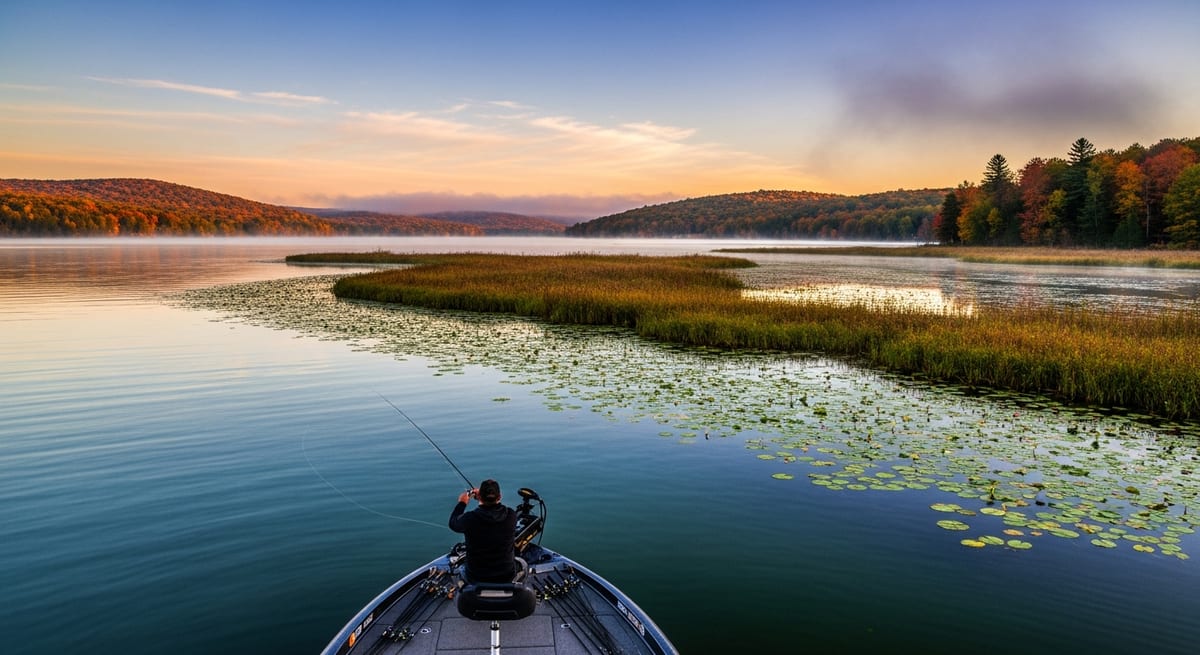
Bass fishing success is largely about pattern recognition, understanding where bass are likely to be given the current season, water temperature, and conditions. An angler who understands seasonal patterns can catch bass consistently across the calendar year. An angler who doesn't understand seasonal patterns catches fish only when they randomly stumble onto feeding fish. This guide covers the full year-round pattern for Connecticut largemouth bass.
Pre-Spawn: Early Spring (March-April, 45-55°F)
As Connecticut lakes begin to warm from ice-out temperatures, bass transition from their deep winter lethargy to actively feeding in preparation for spawning. Water temperatures in the 45-55°F range trigger the first consistent pre-spawn feeding behavior. Location: Bass haven't moved to the shallows yet but are staging on transitional structure, secondary points leading to spawning flats, edges of deep weed beds closest to shallow areas, and any structure (rocks, dock pilings) that absorbs heat and warms faster than surrounding water. Depth: Typically 8-15 feet. Bass will move up briefly to feed, then retreat to deeper thermal refuge. Presentations: Slow is the key in cold water. Bass metabolism is reduced and they won't chase fast baits. Suspending jerkbaits (Rapala X-Rap, Megabass Vision 110) worked with long pauses (5-10 seconds) are excellent. Drop shot with small finesse worms is productive. Tube jigs dragged slowly along the bottom. A football jig dragged at a crawl along rocky transition areas. The retrieve should be the slowest you can manage while still maintaining presentation quality.
Spawn: Late Spring (May-June, 60-72°F)
When water temperatures reach 60-65°F consistently, largemouth bass move to spawn in shallow water. The spawn is the most concentrated shallow-water period of the year. Pre-spawn staging (58-62°F): Bass move to the shallowest feeding areas before actually spawning. This is often the best feeding period of the spring. Fish are actively fueling up. Target secondary points, dock edges, and emerging weed growth in 3-8 feet. Spawn (62-68°F): Males construct nests on hard bottom (gravel, sand) in 1-4 feet of water in protected areas. Fish are highly visible and catchable. See the ethical considerations in our spawning guide before targeting bedding bass. Post-spawn recovery (68-72°F): After spawning, both sexes are temporarily exhausted and recuperating. Males guard nests until fry disperse; females move to adjacent deep water to recover. This can be a relatively slow period for 2-3 weeks. Primary presentations: Swim jigs along weed edges, Texas-rigged soft plastics pitched to visible nests, wacky-rigged Senko in pre-spawn staging areas. Topwater lures along emerging grass lines and weed edges as water warms.
Early Summer (June-July, 72-80°F)
Early summer is often the best all-around bass fishing period in Connecticut. Water temperatures are in the optimal feeding range, fish have recovered from the spawn, and they're aggressively feeding to build reserves for summer. Location shift: Bass move toward deeper structure as surface temperatures rise. Key locations shift to: main lake points, deep weed edges (outside edge of submerged grass in 6-12 feet), dock shade, and bridge pilings. Morning and evening activity peaks. Topwater mornings: Dawn hours in early summer produce excellent topwater action. Glass-calm water at 5:30 AM on a CT lake, casting a Zara Spook along a weed edge. This is peak bass fishing experience. The topwater bite typically lasts until the sun hits the water directly, usually 7-8 AM. Midday presentations: As sun rises and surface temps warm, shift to deeper structure fishing. Football jigs along outside weed edges, swim jigs through submerged grass, and drop shot on main-lake points in 10-15 feet. Evening feeding: Bass return to shallow feeding in the last hour before dark, particularly on overcast evenings. Work the same shallow areas as morning with reaction baits (crankbaits, topwater).
Midsummer (July-August, 80°F+)
Midsummer is often the most challenging period for Connecticut bass fishing. Surface temperatures regularly hit 80-85°F, light pressure is intense, and boat traffic is at its annual peak. Adapting strategy is essential. Depth and cool water: Large bass move to the deepest available structure with cool water, often 15-25 feet on thermocline edges or near cold spring seeps. Deep-water fishing requires heavier gear (3/4 oz football jig, drop shot with 1/4 oz weight) to reach these depths efficiently. Night fishing: This is the best solution to midsummer midday difficulty. Bass move shallow at night when surface temperatures cool. Night topwater and large soft plastics produce the biggest midsummer bass. Dock shade: Bass concentrate in dock shade throughout the day in midsummer. Deep docks with direct access to 8+ feet of water are the best daytime summer targets. Skip soft plastics and swim jigs under the darkest portions. Offshore structure: Points and humps that top out at 12-20 feet (visible on a depth finder) hold summer bass that have abandoned the shoreline entirely. This requires sonar to locate but provides consistent midsummer action away from boat traffic.
Fall Transition (September-November, 65-55°F)
The fall transition is one of the most exciting bass fishing periods in Connecticut. Cooling water temperatures trigger aggressive feeding as bass build reserves for winter. The fall pattern involves following the bait fish (primarily shad in CT waters). The shad migration: As water temperatures drop, shad schools move from main-lake open water toward the backs of coves and tributaries. Bass follow the shad, creating the 'fall baitfish migration' pattern that tournament anglers prize. Find the shad (look for bird activity and surface baitfish activity) and you'll find feeding bass. Reaction bait bonanza: Cool water in the 65-72°F range is prime reaction bait temperature. Bass respond aggressively to fast-moving presentations. Lipless crankbaits (Rat-L-Trap) ripped through grass and over shallow flats are extremely effective. Spinnerbaits worked at medium retrieve through the fall bait schools produce. Topwater frog fishing remains effective into October on warm afternoons. Swimbait presentations that match the shad size. Late fall (50-55°F): As temperatures drop below 60°F, presentations slow down again. Football jig on main-lake points, hair jigs, and slow-rolled swimbaits in 12-20 feet.
Winter (December-March, below 50°F)
Winter bass fishing in Connecticut is the most challenging season but can reward patient, methodical anglers with quality fish. Legal and accessible: CT bass fishing is year-round with no closed season. Lakes rarely freeze entirely in most recent winters. Bass behavior in cold water: Below 50°F, bass are in near-dormancy. Their metabolism is at its annual low. They need to eat less frequently and won't pursue fast-moving presentations. Every movement is energy-costly, so they position in areas that minimize their own energy expenditure (slack water, current breaks) while maximizing prey access. Location: Deep, flat-bottom areas in 15-30 feet where water temperature is most stable. Any areas with thermal mass, dark bottom, springs, or deep coves. That retain heat better than surrounding areas. Presentations: Extremely slow. Blade baits (vibrating jigs) worked with a subtle lift-and-drop along the bottom. Drop shot with a 3-inch finesse worm held stationary for 30 seconds at a time. Tube jigs or ball jigs crawled at a crawl along rocky bottom. The slow retrieve isn't just suggested, in 45°F water, a lure that moves faster than a sluggish fish can comfortably track won't be eaten. The reward: Winter bass that do bite are often quality fish, big females preparing for spring. The fish are less pressured, more concentrated on specific structure, and worth the effort for the dedicated CT angler.
EVERY SATURDAY MORNING
Weekly fishing intelligence
Nationwide conditions, what's biting, and honest gear deals. One email, no noise.
No spam. Unsubscribe anytime.