
Bantam Lake and Quaddick Reservoir Pike Anglers Report the October Weed-Edge Bite Produces More Trophy Fish Than Spring and Summer Combined, what CT DEEP 2025-2026 Freshwater Regulations, Community Ice Reports, and the Barkhamsted Impoundments Reveal About Connecticut's Northern Pike
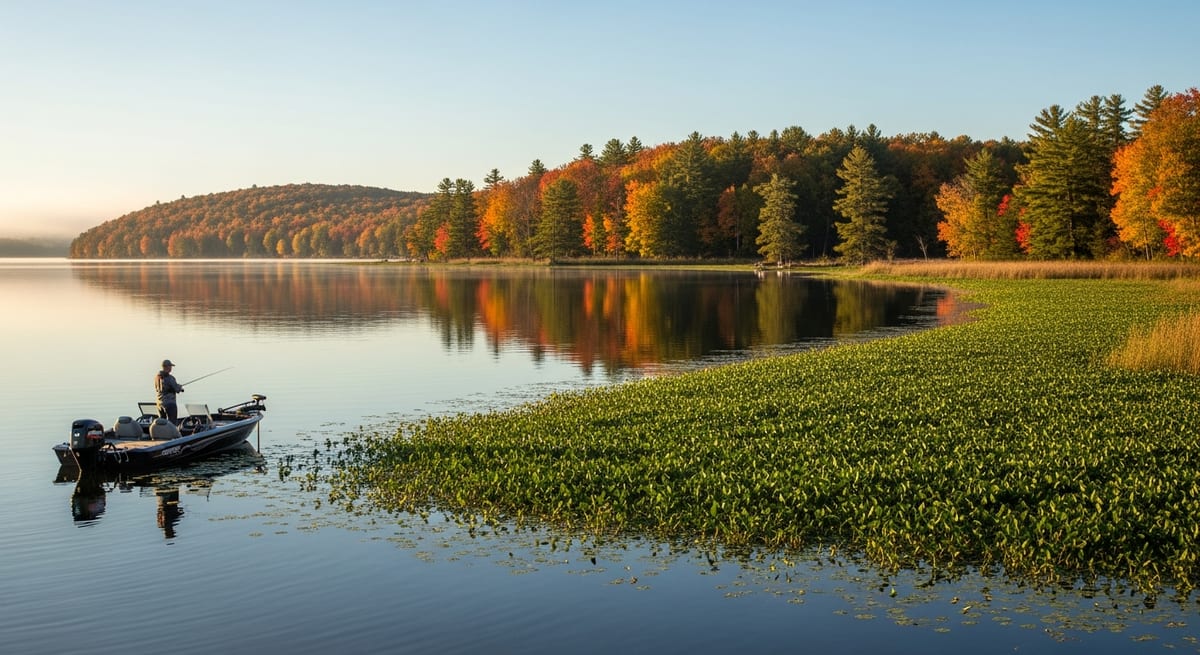
Anglers who fish Bantam Lake's north cove in early October report pike stacked in 4-6 feet over submergent weed beds just before the vegetation browns. A window that closes fast when water drops below 50°F and the fish push into deeper basin structure. The Connecticut state record northern pike came from Bantam Lake in Morris, which puts context around what the shallow weed bed habitat there can produce. While bass fishing draws most CT freshwater pressure, reports from Bantam, Quaddick Reservoir in the northeast corner, and the Barkhamsted-area impoundments describe a trophy pike fishery that most CT anglers have never sampled. These waters can produce fish well into the double-digit pound range, significantly larger than anything most CT bass anglers encounter, and multiple CT pike populations remain viable and accessible year-round.
Where CT Pike Actually Concentrate: Bantam Lake, Quaddick Reservoir, and the Barkhamsted Impoundments
Pike distribution in Connecticut is narrower than bass, but concentrated in waters that tend to produce larger individual fish than pressured bass lakes. Bantam Lake (Morris/Litchfield) is the most documented CT pike destination and the source of the state record. The lake's shallow weed beds along the northern and western shorelines are classic pike habitat, dense submergent vegetation adjacent to open water transitions. Anglers on CT freshwater forums consistently report weed edges from late September through November as the most productive zone, with post-spawn fish in spring as a secondary peak.
Quaddick Reservoir (Thompson) is the least-pressured option for CT pike. Sitting in the northeast corner of the state, it sees considerably less fishing effort than Bantam, and community reports describe productive fall pike action along the reservoir's irregular shoreline, with tip-up anglers reporting consistent results through ice in cold winters.
West Hill Pond and Barkhamsted Reservoir (Barkhamsted/New Hartford area) round out the northern tier. West Hill Pond in particular has produced large pike historically; both impoundments share the deeper, cooler water character that supports trophy-sized fish. East Twin Lake (Ellington) produces pike in north-central CT, drawing local ice-fishing anglers in cold winters. Mashapaug Pond (Union) in the Nipmuck State Forest sees low pressure year-round and consistent reports from anglers willing to seek out remote access.
Chain pickerel are a separate story. According to CT DEEP, pickerel occupy virtually every CT lake, pond, and warmwater river, far more widespread than pike. A pike outing at any of these waters will likely include pickerel encounters. The same presentations that catch pike take pickerel; the difference is mostly size, as pickerel typically run 1-3 lbs in CT water.
October Is the Window, how CT Pike Move Through the Year
Pike are active year-round in Connecticut, but angler reports are not evenly distributed across seasons. The fall window, particularly late September through mid-November, generates the most consistent community-reported success for larger fish.
Spring (March-May): Pike spawn earlier than any other CT warmwater species. They move into very shallow, weedy areas as ice melts, often when water is still in the low-40s°F. Post-spawn females feed aggressively in 3-6 feet along weed edges. Anglers who target this window at Bantam and Mashapaug describe it as quality fishing for large fish, though early-season access conditions can vary.
Summer (June-August): As CT lake temperatures push into the mid-70s°F, pike pull off shallow flats and hold deeper, often suspended over weed beds in 15-25 feet, or near thermal breaks. Anglers on Bantam report significantly reduced shallow-water action by early July. Early morning, before surface temperatures rise, is the most productive summer window.
Fall (September-November): The consensus among CT pike anglers is that October is the single best month. Water has cooled from summer highs, pike return to weed edges and points, and large fish feed actively ahead of winter. Community reports from Bantam consistently describe fish in the 6-10 lb range as achievable during this window, with occasional larger fish. Angler reports from Quaddick mirror the same pattern. The window narrows quickly once water temperatures drop and weeds die back.
Ice Season (December-March): Pike remain active through hard water in CT in a way most other species do not. Tip-up anglers fishing Bantam and East Twin Lake report consistent pike action throughout cold winters, with fish holding over weed beds and drop-offs beneath the ice.
Wire Leaders Aren't Optional: What CT Pike Gear Actually Requires
Pike gear differs from CT bass and panfish tackle in one non-negotiable way: wire leaders. Pike teeth will cut mono, fluorocarbon, and even heavy braid in a single thrash. Anglers who fished Bantam without wire and switched to coated wire leaders report a substantial reduction in cut-offs, especially on subsurface lures that stay in the strike zone longer than a surface bait would.
Rod: A medium-heavy to heavy 7-7.5 foot baitcasting rod handles large lures and provides the backbone to pull pike out of heavy vegetation. A heavy 6.5-7 foot spinning rod works for lighter presentations. The sustained load from casting 1-2 oz spoons repeatedly will expose a soft rod quickly.
Reel: A 200-300 size low-profile baitcaster for heavier lures; a 4000-5000 size spinning reel for lighter setups. Both benefit from a smooth drag. A running pike on light gear can strip line before the angler reacts.
Main line: 30-50 lb braid. Zero stretch aids solid hooksets through weed, and the thin diameter cuts through submergent vegetation more cleanly than mono at equivalent strength.
Wire leaders: A 6-12 inch single-strand or coated wire leader rated to 20-30 lb between braid and lure is standard. Snap swivels on both ends allow fast lure changes. Pre-rigged wire leaders from Mustad, Berkley, and Terminator are widely used by CT pike anglers at Bantam and Quaddick. Treble hook handling: A long-nose pliers or forceps, and a jaw spreader for larger fish, are standard kit, pike mouths contain multiple rows of backward-angled teeth that make hand-removal without tools unreliable.
Spoons, Jerkbaits, and Tip-Up Setups: What CT Pike Anglers Actually Reach For
CT pike anglers at Bantam and Quaddick report a consistent preference for a short list of presentations that produce across seasons, and a matching skepticism about presentations that look effective in video but underperform in CT's weedy, clear-water impoundments.
Large casting spoons (1-2 oz): A silver or gold casting spoon retrieved steadily through weed edges and over shallow flats is one of the most time-tested pike presentations in use. The flash on the retrieve and flutter on the drop triggers the ambush response pike rely on as ambush predators. Dardevle Spoon is the classic reference; Eppinger and the Acme Kastmaster are widely used at CT pike water. Many anglers fish these parallel to the weed edge rather than casting into the weeds, letting the spoon run just outside the edge.
Inline spinners (Size 4-6): Large inline spinners, mepps Aglia with bucktail, blue or silver blade combinations, cover water quickly when locating fish and produce consistent strikes. Blade vibration and flash work across a wide range of retrieve speeds, making them forgiving in early season when water temperature affects pike reaction timing.
Suspending jerkbaits (5-6 inch): Worked on a twitch-pause cadence along weed edges, jerkbaits are particularly productive in cold water. The pause mimics a dying baitfish and gives pike time to commit rather than swipe and miss. Community reports from Bantam's fall season frequently describe this presentation producing larger fish. CT pike anglers consistently note that the pause in cold water needs to be longer than the equivalent bass jerkbait presentation, sometimes 3-5 seconds rather than 1-2.
Paddle-tail swimbaits (5-7 inch): Slow-rolled over and through weed beds on heavy jig heads, swimbaits have become a standard CT pike option. The slow retrieve works in warmer water when a steady spoon retrieve moves too fast for fish holding near cover.
Tip-up live bait: For ice season and spring bank fishing, a 6-10 inch live sucker or large shiner rigged through the back on a size 2 treble, positioned 12 inches off bottom over a weed edge or drop-off, is the standard setup. Tip-up anglers at Bantam and East Twin Lake describe this as the most consistent method for the largest pike, particularly in the February through early March window just before ice-out.
CT DEEP 2025-2026 Pike Regulations and Why Big Females Get a Second Look Before They Go in the Livewell
CT DEEP 2025-2026 freshwater regulations set a 24-inch minimum size and a 2-fish daily creel limit for northern pike statewide. Anglers targeting Bantam, Quaddick, and the Barkhamsted impoundments should verify the current CT DEEP Inland Fishing Guide each season, as size and bag limits can be adjusted between regulation cycles.
The regulated minimum matters more for pike than for many CT species because pike are slow-growing. A female CT pike over 30 inches is likely 10-15 years old. The community consensus among dedicated CT pike anglers, reflected consistently in reports from Bantam regulars on CT freshwater forums, is that large females should be returned. These fish produce substantially more eggs per spawn than smaller individuals, and selective harvest of mid-range fish (24-28 inches) is the practice most CT pike anglers describe as sustainable at current population levels in a state with limited quality pike water.
Handling: Pike should be kept horizontal at all times. Vertical holds by the jaw, standard practice for bass, can damage the jaw structure and internal organs of large pike. Support the body with a second hand under the belly. Wet hands before contact to protect the slime coat, minimize time out of the water, and revive the fish upright in the shallows before release if it shows any signs of fatigue.
Chain pickerel: CT DEEP sets a 10-inch minimum with a more generous creel limit for chain pickerel. Pickerel are widely considered excellent table fare and many CT anglers pursue them deliberately alongside pike. The same wire-leader rigs that catch pike take pickerel. The strikes are often indistinguishable until the fish is visible alongside the boat.
Recommended Gear for CT Pike
These picks match the gear and lure sections above and are in the Hooked Fisherman gear catalog with verified Amazon listings. They are affiliate links (commission at no cost to you).
- Cuda Titanium Bonded Pliers 8": long-nose pliers for the treble hook handling the gear section calls standard kit.
- Acme Kastmaster Spoon: the casting spoon named in the lures section. This listing covers the 3/4 oz and 1 oz sizes, the lighter end of the 1 to 2 oz range.
- Power Pro Spectra braided line: braid for the main line described above. Check the pound test on the listing, since the gear section calls for 30 to 50 lb.
A wire leader is still required between the braid and the lure. Wire leaders are not in the catalog yet, so pick up pre-rigged leaders at a local tackle shop.
Before heading out, check the latest Connecticut fishing reports for current conditions on pike water.
EVERY SATURDAY MORNING
Weekly fishing intelligence
Nationwide conditions, what's biting, and honest gear deals. One email, no noise.
No spam. Unsubscribe anytime.