
Candlewood and Bantam Bass Regulars Report the July Bite Compresses Into a 90-Minute Dawn Window Before Fish Pull to Deep Structure. What CT Impoundment Communities, DEEP Freshwater Regulations, and Summer Thermocline Patterns Reveal About Finding Largemouth Through the Heat
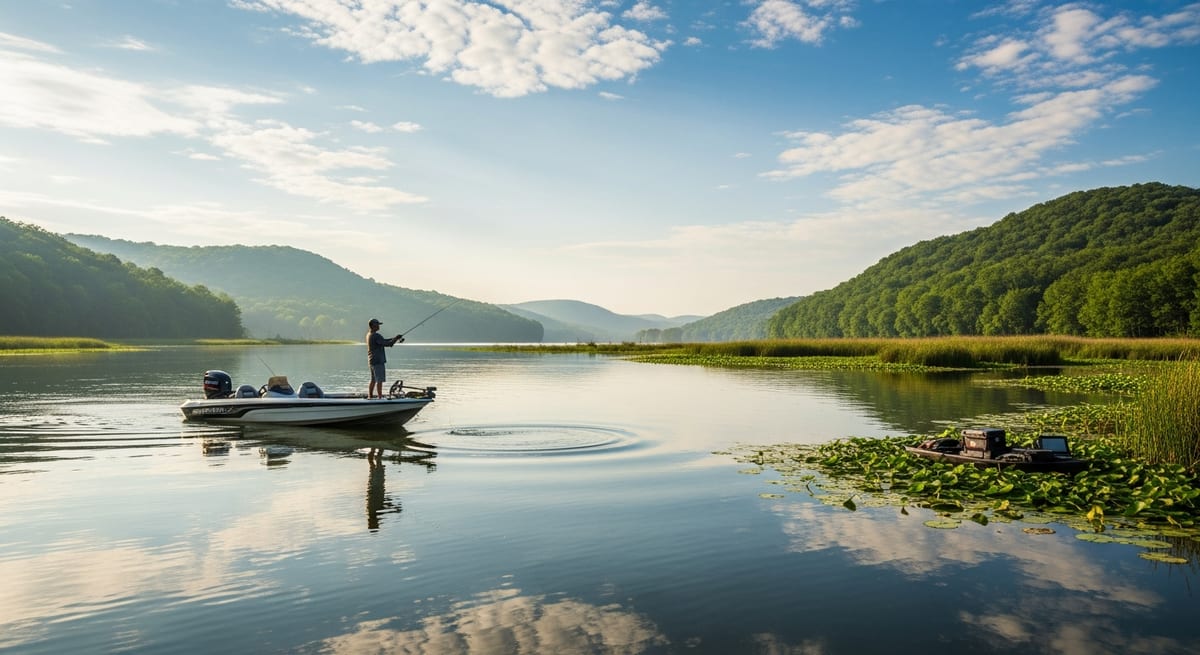
Anglers fishing Candlewood Lake in early July consistently report a pattern that repeats on Bantam and Lillinonah: the shallow bite that produced through the pre-spawn period narrows to a 60-to-90-minute window at first light, then shuts down hard. The bass community on CT's larger impoundments describes the same transition, typically tied to the period when surface temperatures climb into the upper-to-mid 70s, though the exact threshold varies by water and year. What the impoundment community agrees on is the adjustment required: fish that were hitting shallow cover through May and early June are on deep structure by mid-July, and finding them requires a different search pattern than most anglers carry over from spring.
Where CT Impoundment Bass Stack When Surface Temps Peak
Candlewood Lake's basin depth gives bass thermal options that smaller ponds don't offer. Anglers fishing the main lake points off Squantz Cove and the steep drops along the western shore report that mid-July fish concentrate in the 20-to-30-foot range during midday, well below where most shoreline anglers are searching. On Bantam Lake, the shallower basin compresses the pattern differently: club anglers on the local bass circuit report fish moving to whatever submerged structure exists in 12-to-18 feet once morning topwater shuts off.
The consistent holding spots across CT impoundments, based on what the community reports: main lake points that drop from 8-to-10 feet to 20 feet or deeper, submerged creek channels and former roadbeds (Lillinonah holds extensive drowned river structure from the Shepaug impoundment, and anglers familiar with that basin fish it as a primary summer pattern), rock piles on mid-lake humps, and dock pilings in deep-water coves where shade and cooler water converge.
Current matters more in summer than most CT freshwater anglers account for. Boat traffic corridors, dam discharge zones, and the inflow channels from feeder streams introduce oxygenation that concentrates fish when still water becomes thermally marginal. Housatonic River bass anglers report the river pattern stays more active through midday compared to impoundment fish, because moving water maintains oxygen levels that allow feeding behavior to continue past the morning window.
The Dawn Window and Why CT Impoundment Regulars Plan Around It
The bass community on Candlewood and Bantam consistently describes the morning window as the defining feature of summer fishing: roughly 5:30 to 7:30 AM, with the back half of that window often more productive than right at sunrise. Fish move from overnight holding areas toward shallow structure to feed, then pull back as surface temperatures climb and light penetration increases.
Anglers who fish Bantam and the smaller CT impoundments through midday in July and August report that catching fish is possible but requires commitment to deep structure and finesse presentations. The casual shoreline approach that works in May produces very little between 9 AM and late afternoon in July.
The exception the community consistently notes: overcast days. Cloud cover can extend active shallow fishing past 9 AM on CT impoundments and occasionally produces all-day activity comparable to cooler-weather spring patterns. Club tournament anglers on Bantam note that a full overcast in July can keep bass on shallow docks and weed edges through noon.
The evening window, roughly 7 PM to dark, receives less attention than dawn but produces reliably on CT impoundments, particularly along shorelines that took direct sun all afternoon. CT DEEP regulations set legal freshwater fishing hours for most species from one hour before sunrise through one hour after sunset. Anglers targeting the last-light window should verify current-season hours for their specific water at ct.gov/deep.
Topwater on CT Impoundments: The Pre-8 AM Pattern
The Candlewood and Bantam bass community describes topwater as a morning-only pattern once July arrives, concentrated in areas where shallow coves break to depth quickly. Shallow bays with no deep escape route don't hold fish the same way as transition zones where 3-to-4-foot shoreline cover drops to 15 feet or more within casting distance.
What CT impoundment anglers report catching summer bass on at dawn: hollow-body frogs over lily pad mats and dense weed edges (weed growth peaks in July on most CT impoundments, and frog fishing becomes the dominant shallow presentation through August), poppers and chuggers parallel to dock edges and rocky shorelines, buzzbaits for covering open water quickly in low light, and walking baits worked over submerged points.
The Squantz Cove area on northern Candlewood and the protected eastern shore coves on Bantam typically carry lily pad coverage through a normal summer, and the community reports both as consistent frog spots from late June through August.
Approach discipline gets cited repeatedly by impoundment regulars: surface-feeding bass in shallow coves spook easily, and anglers who cut their motors well before casting distance and use trolling motors at minimum speed report fewer fish pushed off before the first cast.
Deep Structure Tactics on Candlewood and Lillinonah
When morning topwater fades on CT impoundments, regulars shift to presentations that reach fish in the 15-to-30-foot range. The basin depth on Candlewood makes this the most significant mid-summer adjustment. Fish that were catchable in 4 feet at dawn are often sitting on ledge structure in 20-to-25 feet by mid-morning.
Carolina rig: the CT tournament community on Bantam and Candlewood consistently rates the Carolina rig as the most reliable deep-water search tool in summer. A 3/4-to-1-oz sinker on a 2-to-3-foot fluorocarbon leader above a buoyant plastic (floating worm, lizard, or creature bait) dragged slowly along main lake point ledges and submerged humps covers water efficiently in the 15-to-30-foot band.
Drop shot: club anglers targeting suspended fish on Candlewood report the drop shot as the most consistent finesse option for fish that won't commit to a moving bait. A 4-inch straight worm on a #1 hook, with the weight 12-to-18 inches below the hook, shaken in place without being repositioned, draws strikes from fish the Carolina rig drags past.
Football jig: heavier jigs (3/4-to-1 oz) with crawfish trailers dragged along rocky bottom in 20-to-35 feet produce the largest bass of the summer pattern, based on what the tournament community fishing Lillinonah's drowned Shepaug riverbed reports. The rock structure in the 20-to-30-foot range on that basin holds fish that rarely get targeted by casual anglers.
Deep-diving crankbaits in the 8-to-12-foot dive range, worked along the upper edge of structure breaks at moderate retrieve speed, complement the slower finesse presentations as a faster search option when covering a new stretch of ledge.
Dock Skipping on CT Lakes: What the Impoundment Circuit Reports
On smaller CT impoundments and in coves off Candlewood's main basin, boat docks concentrate summer bass through midday in a pattern the community describes as reliable enough to plan around. The logic is consistent across waters: shade reduces surface temperature, dock structure creates ambush points, and lights on overnight docks attract insects and baitfish that hold fish in range.
The CT impoundment community's standard approach: skip lures as deep under the dock as possible. The back corners and shaded interior hold more fish than the open outer edges. This is a consistent finding among bass club members fishing the CT lakes circuit, and it distinguishes effective dock fishing from the casual cast-alongside approach that most recreational anglers use.
Lures CT anglers report for dock skipping: 1/4-to-3/8-oz tube jigs or flipping jigs, 4-inch finesse worms on a 1/16-oz shakey head dropped vertically beside pilings, and small finesse swimbaits pitched horizontally along the bottom under the structure. The standard among competitive CT impoundment anglers is to work through a dock quickly (three to five casts covering the shaded interior) before moving on. If a dock holds a catchable fish, it typically reveals itself fast.
Regulation note: the CT DEEP statewide minimum size for largemouth bass is 12 inches, with a 5-fish daily creel limit under the 2025-2026 freshwater regulations. Some CT impoundments carry water-specific slot limits or supplemental rules in addition to the statewide minimum. Candlewood Lake has carried special regulation history in past seasons. Always verify current regulations for your target water at ct.gov/deep before fishing.
Gear the CT Impoundment Community Uses for Summer Patterns
For dawn topwater: a 7-foot medium-action baitcaster with 15-to-20-lb monofilament is the standard recommendation from CT bass club members. Monofilament buoyancy helps surface lures run correctly, and the inherent stretch in mono reduces pulled hooks on explosive topwater strikes that fluorocarbon's stiffness can worsen.
For frog fishing over lily pad mats: a 7-to-7.5-foot heavy baitcaster with 50-to-65-lb braid. The CT tournament community is consistent on this point: lighter line results in broken-off fish in dense vegetation, and the heavier setup is necessary for hauling bass clear of the weed mats that cover sections of Bantam and the northern Candlewood coves in July.
For drop shot finesse: a 6.5-to-7-foot medium-light or medium spinning rod with 8-to-12-lb braid main line and a 6-to-8-lb fluorocarbon leader. Sensitivity matters for detecting the light summer bites that deep-structure fish produce on CT impoundments.
For Carolina rig: a 7-to-7.5-foot medium-heavy baitcaster with 15-to-17-lb fluorocarbon. The longer rod helps load the sweep hookset at the end of a long leader.
For football jig on deep rocky structure: a 7.5-foot heavy baitcaster with 15-to-20-lb fluorocarbon. CT tournament anglers note that deep-water jig fishing prioritizes backbone over sensitivity. The hookset at 25 feet requires a strong, fast sweep, and a lighter rod loses energy over that distance.
EVERY SATURDAY MORNING
Weekly fishing intelligence
Nationwide conditions, what's biting, and honest gear deals. One email, no noise.
No spam. Unsubscribe anytime.